01 What TackNote is
TackNote lives in your system tray and lets you stick a note to a place instead of leaving it loose on your desktop. That place can be an app window, a document, a web page, or a Slack or Teams conversation. When you come back to that place, your note comes back with it. When you leave, it steps out of the way.
Your notes are yours alone. They are stored on your PC and encrypted with your Windows account, there is no sign-up, and we never see what you write. TackNote is a one-time purchase with a free trial, and the same license works on your Mac too.
02 Installing TackNote
- Go to tacknote.app/windows on your PC, enter your email address and accept the License Agreement. The installer, Setup.exe, downloads right away.
- Open Setup.exe. It is signed by Keepers Code, LLC, and every file inside carries our signature, so Windows can check it before it runs. TackNote installs and opens on its own.
- Look for the TackNote icon in the system tray, at the right end of the taskbar near the clock. It is a cream sticky note with a red pushpin.
- A short walkthrough points out the essentials. You can replay it anytime: right-click the tray icon and choose Show Walkthrough.
The tray icon
- Click the icon to open TackBoard, where every note lives.
- Right-click it for everything else: sticking notes, Capture Text, Jump to a Note's Window, Settings, Send Feedback and more.
TackNote opens by itself when you sign in to Windows, so your notes are always ready. To change that, open Settings > General and turn off Open TackNote when I sign in to Windows.
03 Your first note
- Click into the window or page you want to annotate, so it is in front.
- Press Ctrl Alt N, or right-click the tray icon and choose Stick Note to Current Window.
- A fresh note appears on that window, ready for typing.
That is the whole idea. The note stays tied to that window or page. Switch away and it hides. Switch back and it returns, right where you left it. There is nothing to save. Your note is written to disk, encrypted, as you type.
Keyboard shortcuts
- Ctrl Alt N sticks a note to the current window.
- Ctrl Alt F makes a new floating note on your desktop.
- Ctrl Alt Shift N stacks a new note onto the current window's note.
- Ctrl Alt B opens TackBoard.
- Ctrl Alt O captures text from your screen into a new note.
Choosing your own. Open Settings > Shortcuts, click a keyboard field and press the keys you want. A shortcut needs Ctrl, Alt or Win. If you pick a combination another TackNote action already uses, TackNote refuses it, so two actions never answer the same keypress. If another app on your PC already owns a combination, TackNote tells you under that row so you can pick a different one.
Mouse buttons. The first four actions can also go on a mouse button. Click a mouse field, then press your middle, back or forward button, holding Ctrl, Alt, Shift or Win with it if you like. If your mouse software has remapped a button, set that button back to its default there, or map it to TackNote's keyboard shortcut instead.
04 Where a note sticks
TackNote can anchor a note to several kinds of place:
- An app window. Pin a note to any app window. It reappears whenever that window is in front.
- A document. In apps like Word, Excel, PowerPoint, Notepad and Acrobat, TackNote asks whether the note belongs to this document only or to every window of the app. Your answer can be remembered, and changed in Settings under Document scope.
- A web page. In Chrome, Edge, Firefox, Brave, Opera, Vivaldi and other popular browsers, a note is matched by the page's web address. It comes back when you revisit that address, even in a new tab, and even when the page changes its own title.
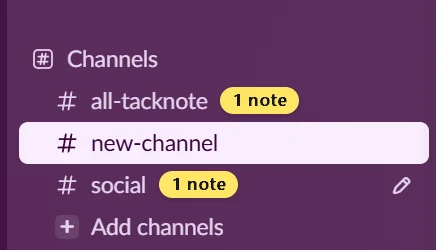
- A chat conversation. In Slack, a note belongs to the channel or direct message you stuck it to. In Microsoft Teams, it belongs to that chat. Switch to another conversation and the note steps aside. New-message counts in the title never make it vanish.
- A code project. In VS Code, Cursor and Windsurf a note sticks to the workspace folder, so it stays put as you move between files.
- A folder. Stick a note to a File Explorer window and it belongs to that folder.
- Your desktop. A desktop note is not tied to any window. Press Ctrl Alt F for one that floats above all windows. If you stick a note with nothing in front, TackNote asks whether it should sit on the desktop or float above everything.
Desktop notes and virtual desktops
A desktop note follows you to every virtual desktop by default. To keep one on a single desktop, open the note's More tools menu (the three dots) and turn off Show on All Desktops. It then stays on the desktop it is on now, and comes back there after a restart. The same menu has Float Above All Windows. From the tray menu you can also Bring Desktop Notes to Front, Send Desktop Notes to Back, or Tidy Desktop Notes into a Grid.
The binding pill
Each note shows a small pill next to its label that names what it is stuck to: the app, the website, or Desktop. Hover it to see the exact window. Click it to open the note's menu, where you can move or unstick the note.
Note pills: where your hidden notes are
When you click into another window, a note steps aside so it never covers your work. The window it belongs to keeps a small "1 note" tag on its top edge, in the note's own color, so you can see where your notes are waiting. Click the tag and that window comes to the front with its notes.
- Slack. A note on a channel or direct message puts its tag right after that conversation's name in the sidebar. Click the tag to open the conversation, and its note comes back. Tags fade out while you scroll the list and return once it stops.
- Slack and Teams windows. The window itself shows how many notes are waiting on your other conversations, even while you are using the app.
A window behind another window keeps its tag behind it too, so tags never float over the app you are using. To turn them off, open Settings > General and turn off Show note pills.
05 Moving a note
Work moves. A note can move with it, keeping everything it holds. This is called re-sticking.
- Open the note's menu. Click the three dots (More tools) on the note's toolbar, or click its binding pill.
- Choose "Re-stick: pick a new home". A banner appears on the note, and the note stays on screen while you move around.
- Click the window that should be its new home. Another app, a browser tab, a document or a folder. The banner names it, for example "Stick to Chrome: this tab?"
- Click Stick Here. The note binds to that window, right where you placed it.
The note keeps its text, to-dos, color, reminders and any flaps stacked behind it. Only what it is pinned to changes.
More ways to change where a note lives
- Tack to Whole App. In the More tools menu, this shows the note on every window of that app instead of one window or document.
- Unstick. Choose Unstick: make this a desktop note to release the note where it sits. It stays on screen instead of following a window.
When the thing a note was stuck to is gone
Delete a file or folder a note was stuck to, and the note is not lost. Its pill says the file no longer exists, and the note lands in Needs a Home in TackBoard's sidebar. Right-click its card and choose Re-home, then click the new window and choose Stick Here. Nothing is deleted just because its home disappeared.
06 Stacking notes
More than one note can share the same home. When they do, they stack, and the stack shows a row of tabs, called flaps, across the top of the front note. Each flap carries that note's label, so you can tell them apart at a glance.
- Drag one note onto another to stack them. The note underneath lights up with a blue outline, and when you let go the dragged note becomes a flap of that stack, taking its home, place and size.
- Choose Stack a New Flap from a note's More tools menu, or press Ctrl Alt Shift N while its window is in front, to add a fresh note to the stack.
- Click a flap to bring that note to the front.
- Right-click a flap and choose Peel Off as Its Own Note to take it back out of the stack.
A stack of any size keeps its flaps. When there are too many for names to fit, the flaps show numbers, and a flap marked with three dots lists every note in the stack so you can jump straight to one.
Minimizing a note
The button at the far left of a note's toolbar shrinks it to a small pin. Click the pin to open the note again. You can choose the pin's size in Settings under Pin size.
07 When a note goes missing
A note can be perfectly healthy and still be somewhere you cannot see it. The window it belongs to may be closed, a display may have been unplugged, or a desktop note may have ended up past the edge. Nothing is lost, and TackNote can fetch it back.
One note
Open TackBoard, right-click the note's card, and choose Jump to Note. TackNote brings the window it belongs to back to the front, and the note comes with it. If that window is closed, TackNote reopens the page, document or folder when it can. You can also right-click the tray icon and use Jump to a Note's Window for your recent notes.
For a desktop note, the card's menu also has Bring to Center of Screen, which moves the note to the middle of your main screen.
All of them at once
In TackBoard, click the three dots in the top bar and choose Find Lost Notes. It brings back only the desktop notes that are actually off screen and leaves everything you can already see exactly where it is. If nothing was lost, it tells you so.
Which one should you use?
- Jump to Note when you want to get back to a note and its window.
- Bring to Center or Find Lost Notes when a desktop note is fine but you cannot see it.
- Re-stick when you want to move a note to a different window, page or folder on purpose.
- Re-home when the thing it was stuck to is gone. These notes are gathered under Needs a Home.
08 Keeping TackBoard out of the way
TackBoard opens in the middle of the screen, which is exactly where your notes live. If you would rather it waited off to one side, it can.
Click the stash button (the pushpin) in TackBoard's top bar. The board tucks itself off the edge of the screen and leaves a small flag behind.
- Hover or click the flag and the board slides back out.
- Right-click the stash button to pick which edge it uses: Left, Right, Top or Bottom. Right is the default.
- You can also stash the board from TackBoard's Window menu, with Stash Away.
The flag follows your paper theme. To give it a color of its own, open Settings > General and turn off TackBoard flag follows the paper theme.
09 Writing notes
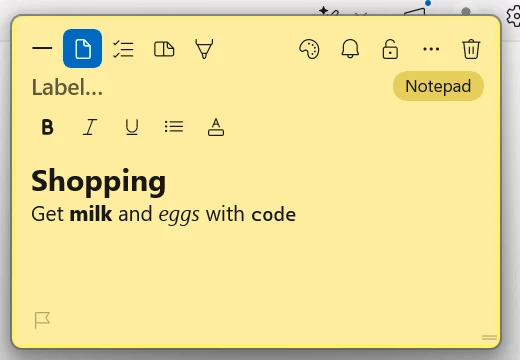
A note is more than plain text. Along its toolbar you will find four views:
- Notes for free-form text.
- To-do for a checklist. Press Enter for a new item, Tab to nest it under the one above and Shift+Tab to bring it back out. Checking a parent checks its sub-tasks too. Done items fold away under a progress line you can click to show them.
- Split view for notes and to-dos side by side. Choose side by side or top and bottom in Settings. Typing "todo" on a line of its own and pressing Enter opens Split view for you.
- Sketch for freehand drawing, with four ink colors, four pen sizes (Fine, Medium, Bold, Marker) and an eraser in four sizes that removes only what it touches. A stylus draws thicker lines the harder you press.
Formatting
- The formatting bar gives you bold, italic, underline, bullets, font, size and text color. Click the font button on the toolbar to show or hide it.
- Ctrl B, Ctrl I and Ctrl U work as you would expect.
- Ctrl Shift 8 turns the current line, or everything you have selected, into a bullet list. Press it again to turn the bullets off. Bullets continue on the next line, and Enter on an empty bullet ends the list.
- Markdown. If you write in Markdown, a note shows headings, bold, italic, code and links formatted while you are not editing it. Click it to edit the text as written.
- Math. Type a sum like "12.50 + 4.75" or a conversion like "10 miles in km" and press Enter. The answer appears on the same line. You can turn this off in Settings.
Color, label and priority
Click the color button to cycle through your five quick colors. Right-click it for swatches, a custom color and the note's opacity. Give a note a label in the line at the top, and use the flag at the bottom left to mark it flagged or high priority.
Deleting and minimizing
The trash button on the far right of a note's toolbar deletes the note, and TackNote tells you so with an Undo in case you change your mind. Deleted notes also wait in TackBoard under Recently Closed. To get a note out of the way without deleting it, use the minimize button on the far left instead.
10 Pictures, voice memos & text capture
Pictures
Paste a picture into a note with Ctrl V, or drag one in from File Explorer or your browser. Pictures sit along the bottom of the note as thumbnails.
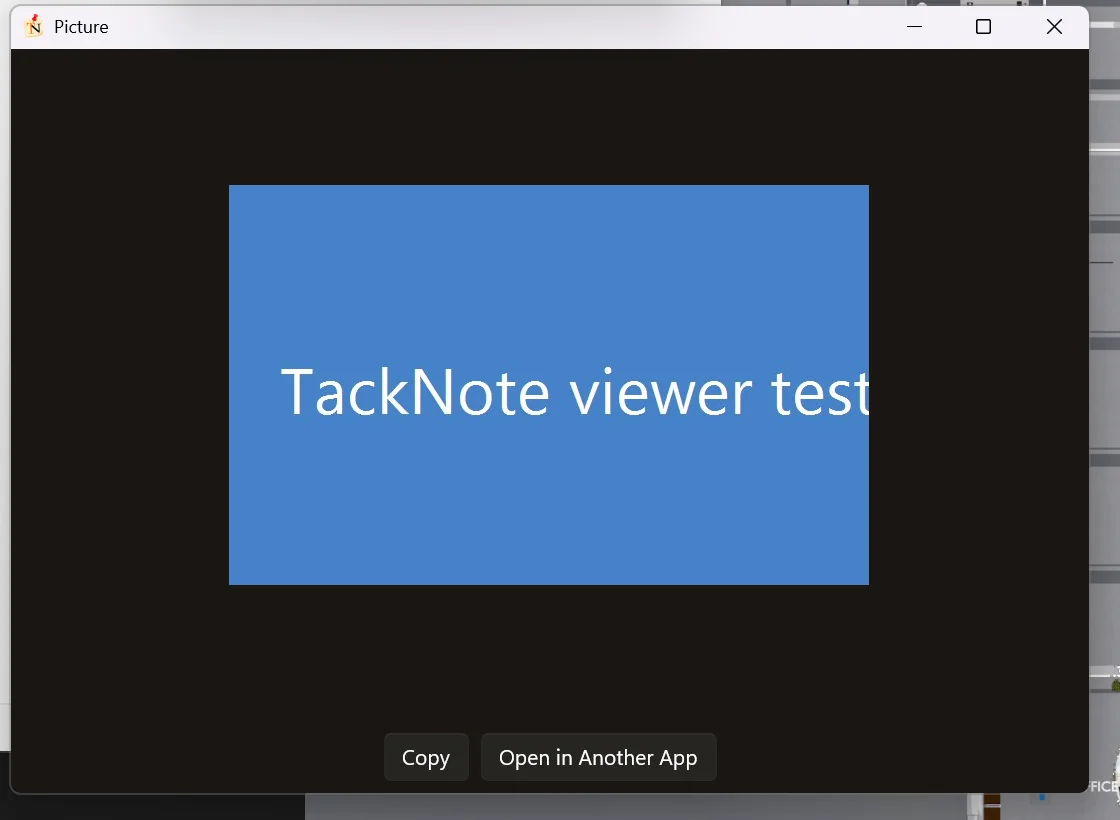
- Click a picture to open it in TackNote's viewer, where you can zoom, step through the note's pictures with the arrow keys, and copy one.
- Right-click a picture for Open Image, Copy Image and Delete Image.
- When a picture you add has text in it, TackNote reads that text on your PC and asks whether to Copy Text into the note or keep Just the Image. Your answer can be remembered, and changed in Settings under Text in dropped images.
Pictures are encrypted on your PC, the same way your notes are. The viewer opens them in memory only. For a note that is not private, the viewer also offers Open in Another App.
Voice memos
Click the microphone on a note to start recording, and click it again to stop. The memo appears at the bottom of the note. Click it to play or pause, and right-click it to delete it. Voice memos are kept as audio, encrypted on your PC.
Capture Text from Screen
Press Ctrl Alt O, or choose Capture Text from Screen from the tray menu. Your screen freezes; drag a box around any text, even text you cannot normally select, like a picture, a video or an error dialog. TackNote reads it with Windows' own on-device text recognition and puts it in a new floating note. The capture button on a note's toolbar does the same thing and adds the text to that note instead. Nothing is uploaded to do it.
11 TackBoard
TackBoard is your notebook: one place to see every note at once, whether or not you are near the window it belongs to. Click the tray icon or press Ctrl Alt B to open it.
- Every note appears as a card. A card and its floating note are the same note, so a change to one shows up in the other. Type straight into a card.
- Search every note's label, text and checklist items from the box at the top, or press Ctrl F.
- Group cards by app, project or sub-folder, and sort them by date updated, date created, title or priority.
- The sidebar narrows the board to To-dos, Reminders, Tacks with Photos, Needs a Home, a project, or one app.
- Click the expand button on a card, or right-click it and choose Open, to read and edit a longer note in a larger view.
- Ctrl+click cards to select several, or Shift+click for a range, then move them to a project, recolor them or delete them together.
- Pick a board background (Cork, Card, White or Black), switch to Compact cards from the three dots, or set the board to Chaos in Settings for a scattered corkboard look.
Board notes
Click + Board note for a note that lives on TackBoard only, stuck to nothing. Type straight into its card. When you want it on a window or page after all, right-click the card and choose Re-stick. + New note makes a floating desktop note instead.
Recently Closed
Deleted notes wait in Recently Closed at the bottom of the sidebar. Restore puts a note back where it was. Delete All empties the list for good, after asking first.
12 Projects & organizing
As your notes add up, projects keep them tidy.
- File a note into a project with the folder button on the note. Choose New Project to start one. Notes from any app can share a project.
- In TackBoard's sidebar, right-click a project for New Sub-folder, Rename Project and Delete Project. Sub-folders can be renamed and deleted the same way.
- Deleting a project or sub-folder that holds notes asks whether to keep the notes or delete them too. Notes you delete this way go to Recently Closed, so one Undo brings them back.
- Drag cards onto a project in the sidebar to file them.
13 Private notes
Some notes are for your eyes only. Click the lock button on a note to make it private. A private note is covered until you click it and unlock with Windows Hello (your face, fingerprint or PIN). On a PC without Windows Hello, TackNote asks for your Windows password instead.
- One unlock opens every private note for 5 minutes by default. Change that in Settings under Keep private notes unlocked for, up to until the screen locks.
- Right-click the tray icon and choose Lock Private Notes Now to cover them again straight away.
- While locked, a private note's text stays out of TackBoard's search, its reminders say only "Private note", and its pictures cannot be opened in another app.
- Private notes never leave your PC, even with sync turned on.
The lock button controls privacy, and the folder button controls which project a note lives in. You can use either, or both.
14 Reminders
Click the bell on a note to have TackNote remind you. Choose In 1 hour, In 3 hours, This evening, Tomorrow, Next week, or a custom date and time. Reminders can repeat every day, every weekday, every week or every month.
When a reminder is due, a Windows notification shows the note. Pick a snooze from its list: 15 minutes, 1 hour, Tomorrow, same time or Next week, same time, then click Snooze. Same time means the time the reminder was set for, so a nine o'clock reminder is still a nine o'clock reminder tomorrow. Click Done when it is handled, or Open to go to the note.
Nudge me next time I open this
Not every reminder needs a clock. Choose Nudge me next time I open this from the bell menu, and the note gives a little pulse the next time you come back to its window.
15 Themes & appearance
TackNote ships with fourteen note skins in three families. Choose one in Settings > General, under Paper Theme:
- Classic for clean, solid colors.
- Paper for printed textures like Kraft, Ruled Notebook, Graph, Dot Grid, Linen and Comic.
- Glass for frosted notes that let your desktop show through, including Neon and Prism.
Settings also sets the default color, text color and opacity for new notes, the five quick colors the color button cycles through, and whether TackBoard and Settings match Windows' light or dark mode.
16 Syncing with your Mac and other PCs
TackNote syncs through a folder you already sync between your computers: OneDrive, Dropbox, Google Drive, or iCloud Drive (with Apple's free iCloud for Windows). Everything TackNote keeps in that folder is encrypted with a passphrase you choose, so the cloud service only ever sees scrambled data. We run no servers for this and never see the contents.
- On your PC, open Settings, go to Sync, click Choose a Folder and Turn On Sync, pick the folder, and choose a passphrase.
- On your Mac, open Settings, choose Sync with Windows, pick the same folder and enter the same passphrase. On another PC, do the same as step 1. TackNote sees the folder is already set up and asks for your passphrase.
- Notes stuck to web pages and desktop notes appear on every computer. A note stuck to an app that only exists on the Mac shows on TackBoard here, under that app.
- Notes arrive with their pictures and voice memos.
- When the same note is edited in two places, the newest edit wins.
- Private notes never leave the computer they were written on. Making a note private also removes the copies already on your other computers.
- The Sync pane shows when you last synced and which other computers are syncing. Use Sync Now there or in the tray menu to sync straight away.
Turn Off Sync stops this PC from syncing. Its notes stay here, and your other computers keep theirs.
17 Backups & importing
Safety Backups
TackNote copies your notes automatically every time it updates, and once a day. It keeps the 12 most recent copies, still encrypted, on your PC. To go back to one, open Settings > Data, click Safety Backups, choose a copy and click Restore and Restart. Your notes as they are now are saved as a backup first, so nothing is lost.
Export and import a backup
Export Backup in Settings > Data saves all your notes, encrypted with a passphrase you choose. Import Backup opens a TackNote backup made on Windows or on a Mac. Notes already here are skipped, and Mac notes stuck to apps that do not exist on Windows wait in TackBoard under Needs a Home.
Import from Files
Bring notes in from other apps with Import from Files. It reads Markdown, plain text, HTML (such as a Google Keep export), RTF and Evernote exports (.enex). You give the batch a label, and the notes wait in TackBoard under Needs a Home until you stick them somewhere.
Open Notes Folder shows where TackNote keeps everything, in File Explorer.
18 License & trial
TackNote is free to try for 7 days, with everything unlocked. The tray menu shows how many days are left. When you are ready, one purchase covers up to three computers, Mac or Windows, in any mix.
- Activating. Your license key arrives by email after you buy. Right-click the tray icon, choose the trial line at the top (or License), paste the key and click Activate. If TackNote is already installed when you buy, the thank-you page also has an Activate on this PC button that activates it in one click, after TackNote asks you to confirm.
- Moving a seat. If all three seats are in use, TackNote asks which computer to move the license from. You do not need that computer to hand. To free a seat yourself, choose Deactivate This PC in the License window.
- When the trial ends. Your notes all stay right where they are, and you can still read every one. Editing and new notes wait until you add a license.
19 Updates
TackNote keeps itself up to date. It checks for a new version when it starts and once a day, downloads it quietly in the background, and installs it the next time TackNote starts. When an update is ready, TackNote lets you know and offers Restart Now if you would rather not wait. To check yourself, right-click the tray icon and choose Check for Updates.
Before any update touches your notes, TackNote takes a Safety Backup, so you can always go back to how they were.
If TackNote ever closes unexpectedly, it offers to send us a short crash report the next time it opens. You see exactly what will be sent first, and nothing goes unless you choose Send Report.
20 Your privacy
- Encrypted on your PC. Your notes, pictures and voice memos are encrypted with your Windows account, so only you can read them on this PC.
- No account. There is nothing to sign up for, and your notes are never uploaded to us.
- On-device text recognition. Capture Text and picture text are read by Windows on your PC.
- What TackNote sends. TackNote contacts us only to check your trial and license, to look for updates, and to send feedback or a crash report when you choose to. None of that includes your notes.
- Sync stays yours. Sync uses your own cloud folder, encrypted with your passphrase.
Unlike the Mac, Windows does not ask you to approve permissions for TackNote, so there is nothing to set up.
21 Pro tips
A few power moves once you have the basics down:
Put it on a spare mouse button. Map Stick note to current window to your mouse's back or forward button. Now a note is one thumb-click away, without reaching for the keyboard.
Group everything into Projects. File related notes into a project, then add sub-folders for bigger efforts. A busy board stays calm, and you can focus on one piece of work at a time.
Lock anything sensitive. Mark a note private and it stays covered until Windows Hello. Client details and personal notes never show at a glance, even with your screen shared.
Give every channel its own note. In Slack, stick a note to a channel for its open questions. The sidebar tag shows which channels have one, and the note appears the moment you open that channel.
Grab text you cannot select. Press Ctrl+Alt+O and drag around an error message, a slide in a video call or a scanned page. The words land in a note, ready to search and paste.
Let the note do the math. Type "lunch 12.50 + coffee 4.75" and press Enter. TackNote adds it up on the same line, and it converts units like "10 miles in km" too.
Let TackBoard find it for you. Forgot where you stuck a note? Press Ctrl+Alt+B and start typing in the search box. Right-click the card and Jump to Note takes you straight to its window.
One license, both computers. Use TackNote on your Mac at home and your PC at work with the same key, and sync web-page notes between them through a folder you already use.
22 Getting help
Stuck, or have an idea? We would love to hear from you. Right-click the tray icon and choose Send Feedback, pick Bug, Idea or General, and leave your email if you would like a reply. Or email [email protected]. The FAQ answers the most common questions, and the changelog tracks what is new.
Using TackNote on a Mac too? The Mac user guide covers the Mac app.